
ForgeGraph
Sample AI & Product Diagnostic
Sample Diagnostic deliverable based on the fictional ForgeGraph demonstration—not a customer engagement.
Observed
This retrospective sample demonstrates GreyX's diagnostic format using reviewed ForgeGraph demonstration material and approved public assets; it is not customer work or a past delivery.
Executive decision summary
Observed
The reviewed design separates backend-controlled durable state from ephemeral execution work.
Analysis
Preserving the durable-state boundary, making human approval and recovery evidence inspectable, and validating concentrated orchestration areas are the most defensible next decisions.
Recommendation
Validate the ownership boundary and recovery behavior before considering any stack change.
Method, evidence, and limitations
Observed
This sample uses reviewed demonstration material and approved public assets while excluding source code, repository data, private operational material, raw graph or index data, prompts, credentials, local paths, and the internal code index from publication.
Observed
This sample does not establish live workload, user behavior, costs, service levels, performance, security posture, production deployment status, or commercial results.
Sample Diagnostic deliverable based on the fictional ForgeGraph demonstration—not a customer engagement.
Current system and product objective
Observed
The reviewed demonstration combines product workflow, durable state, execution, AI assistance, and explicit human decision points.
Observed
The review is limited to public evidence: it includes no runtime measurement, stakeholder interview, or customer data, and uses a deliberately simplified system map.
Assumption
Assumption: a team may need to coordinate operational work with explicit decision gates; this sample framing requires validation.
Architecture and ownership boundaries
Observed
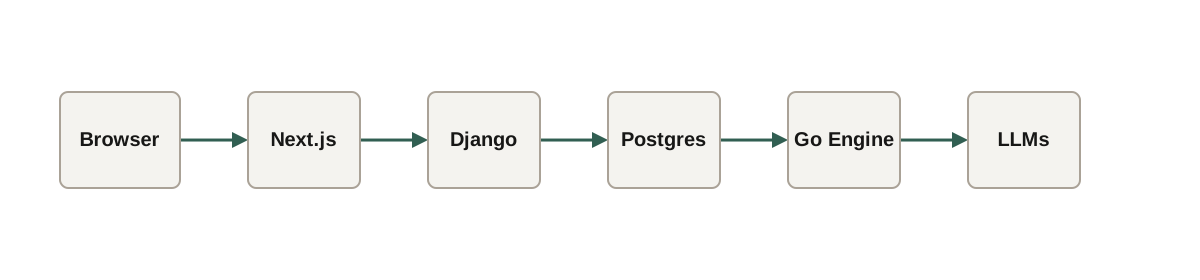
The simplified public sequence is Browser -> Next.js -> Django -> Postgres -> Go Engine -> LLMs.
Observed
The reviewed separation assigns durable control-plane authority to the backend and keeps execution work ephemeral.
Observed
The reviewed projection can be reconstructed from backend-owned data after cache-only loss.
Observed
The reviewed delivery boundary retains durable, retry-aware semantics separate from decision state.
Strengths worth preserving
Observed
Durable-state ownership is explicitly separated from ephemeral execution work in the reviewed design.
Observed
Human approval is modeled as explicit workflow and decision state in the reviewed demonstration.
Observed
Recoverable projections and retry-aware delivery boundaries are worth preserving as explicit design choices.
Sample Diagnostic deliverable based on the fictional ForgeGraph demonstration—not a customer engagement.
Prioritized risks and opportunities
Priority 1
Recommendation
Make ownership boundaries and recovery expectations explicit and regression-tested.
Priority 2
Recommendation
Make high-impact human approval evidence and decision state easy to inspect.
Priority 3
Recommendation
Exercise cache-loss and checkpoint-loss behavior as product behavior, not only infrastructure behavior.
Priority 4
Analysis
Several reviewed controller/orchestration units coordinate many product-critical responsibilities; characterize their boundaries and test coverage before deciding whether focused decomposition is warranted.
Priority 5
Recommendation
Improve operator visibility into failed or deferred external delivery while retaining durable, retry-aware semantics.
Sample Diagnostic deliverable based on the fictional ForgeGraph demonstration—not a customer engagement.
ADR-001 — Preserve a backend-controlled durable control plane with an ephemeral execution plane
Context
Analysis
A durable control plane and an ephemeral execution plane make ownership and recovery expectations reviewable as separate concerns.
Observed evidence
Observed
The reviewed design keeps durable runtime state under backend control rather than assigning it to ephemeral execution work.
Options
Recommendation
Recommendation
Preserve the separated ownership model.
Not recommended
Analysis
Letting execution own durable runtime mutation is not recommended because it would require a different ownership and recovery model to be validated.
Not recommended
Analysis
Treating events as the authoritative state source is not recommended without separately validating a different durable-state model.
Recommendation
Recommendation
Preserve the separated ownership model.
Trade-offs
Analysis
Preserving the boundary keeps recovery and ownership explicit, while future changes must continue to validate those trade-offs.
Consequences
Analysis
Preserving the boundary keeps recovery and ownership explicit, while future changes must continue to validate those trade-offs.
Validation criteria
Recommendation
Preserve the separated ownership model.
Remaining uncertainty
Open Question
Which current responsibilities and tests should be characterized before a focused decomposition decision?
Roadmap and suggested technology direction
First
Recommendation
First, formalize invariants, the decision record, and characterization tests.
Next
Recommendation
Next, improve approval, recovery, and operator visibility.
Then
Recommendation
Then decide whether focused decomposition or additional product work is warranted.
Analysis
The conservative direction is to preserve the reviewed Next.js, Django, Postgres, Go-engine, and LLM boundary vocabulary where it serves the ownership model.
Implementation phases, timeline, and commercial framing
Observed
GreyX's AI & Product Diagnostic is USD 350 fixed and delivered in three business days through Day 1 Discovery, Day 2 Analysis, and Day 3 Delivery.
Observed
GreyX's Build Sprint starts at USD 2,500 and generally takes one to three weeks; Product Partnership is custom quote.
Recommendation
Keep a suggested sequence separate from commercial facts and treat follow-on offers as conditional next engagement options.
GreyX Diagnostic method
- Day 1 Discovery
- Day 2 Analysis
- Day 3 Delivery
Offer facts
- AI & Product Diagnostic — USD 350 fixed — 3 business days
- Build Sprint — starts at USD 2,500 — one to three weeks
- Product Partnership — custom quote
Open questions
Open Question
Which real user or operator roles need this workflow, and which outcome should be prioritized?
Open Question
What production evidence, if any, is available for the real system?
Open Question
What approval policy, recovery expectation, external-delivery consequence, data constraint, and investment guardrail should shape a real Day 1 working call?
Suggested next step
Recommendation
Contact GreyX to discuss a USD 350, three-business-day AI & Product Diagnostic.
Evidence and provenance appendix
Observed
This appendix publishes public-safe evidence labels, scope, confidence, and limitations only; source code, repository data, private operational material, raw graph or index data, prompts, credentials, local paths, and the internal code index are intentionally not published.
Sample Diagnostic deliverable based on the fictional ForgeGraph demonstration—not a customer engagement.
- E1 — Durable-state boundary
- Evidence record: Reviewed separation of backend-controlled durable state and ephemeral execution work.
- Confidence: High
- This public summary does not describe deployment topology, uptime, or performance.
- E2 — Recoverable projection
- Evidence record: Reviewed reconstruction of a cache-backed projection from backend-owned data.
- Confidence: High
- This does not establish incident history or a reliability result.
- E3 — Human approval state
- Evidence record: Reviewed explicit approval and decision state in the demonstration workflow.
- Confidence: High
- This does not establish a real customer's governance policy.
- E4 — Retry-aware delivery
- Evidence record: Reviewed durable, retry-aware treatment of external delivery state.
- Confidence: High
- This does not establish delivery rate, scale, latency, or production operation.
- E5 — Public architecture map
- Evidence record: Approved simplified public system sequence.
- Confidence: High
- The map is intentionally simplified and is not a production topology.
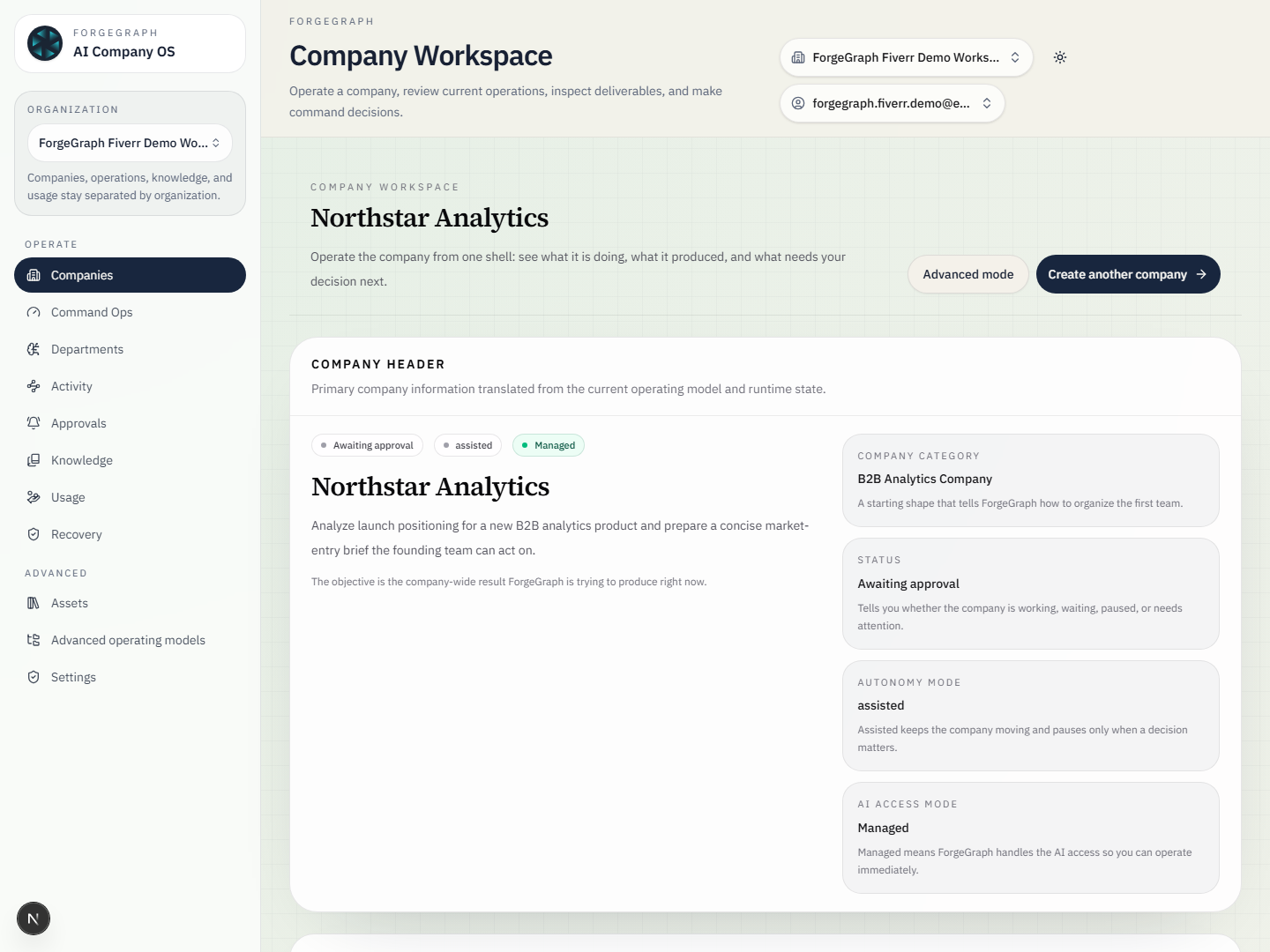
- E6 — Fictional workspace capture
- Evidence record: Approved isolated fictional UI/workflow capture.
- Confidence: High
- It is not evidence of a client, customer, revenue, users, deployment, or outcome.
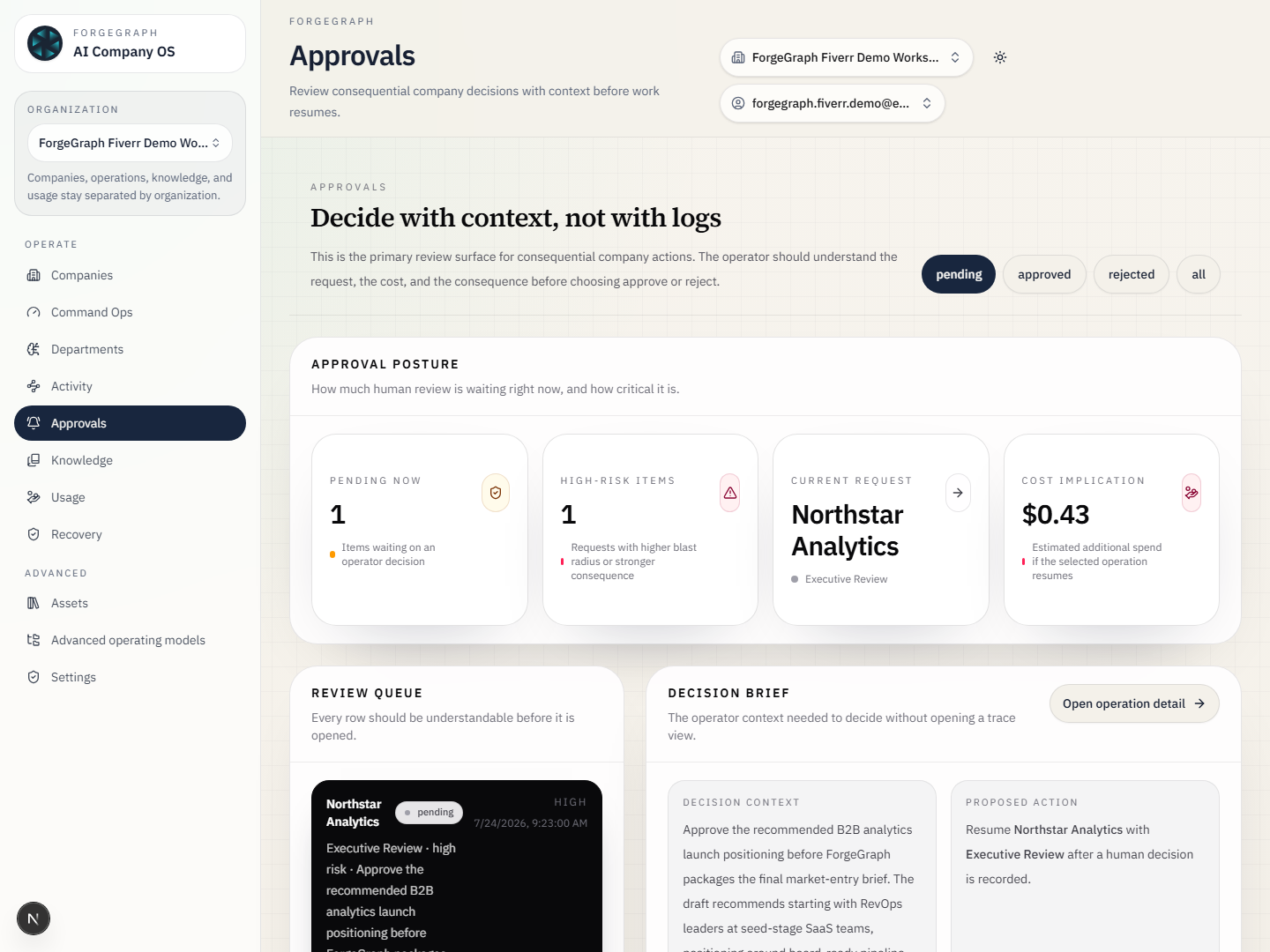
- E7 — Fictional approval capture
- Evidence record: Approved isolated fictional approval-workflow capture.
- Confidence: High
- It is not evidence of a client, customer, revenue, users, deployment, or outcome.
- E8 — Reviewed maintainability signal
- Evidence record: Read-only current controller/orchestration responsibility and relevant deterministic-coverage review, informed by bounded static-analysis candidates.
- Confidence: Medium
- Structural characterization only; no defect, incident, slowness, production risk, performance result, required rewrite, source path, identifier, line count, score, or excerpt.
- C1 — GreyX Diagnostic offer
- Evidence record: Current GreyX offer facts for the AI & Product Diagnostic and follow-on options.
- Confidence: High
- The facts are not a ForgeGraph estimate, quote, spend record, engagement timeline, or commitment.